
Greg Kocis: A Musical Timeline
 Greg Kocis
This is an ongoing chronological account of Greg Kocis’s musical journey, from his early years as a drummer in Pittsburgh to songwriting, recording, music production, online education, YouTube, and AI-assisted music. Along the way, it includes the people, places, bands, recordings, and life events that helped shape the music.
Although written primarily in the third person, this timeline is written and maintained by Greg Kocis and is based on his personal memories, records, research, and ongoing recollections. Some dates and details may be updated as additional information is remembered or verified.
Musical Beginnings (1983–1990)
Discovering Music and Percussion
Greg Kocis was born in Pittsburgh, Pennsylvania, and grew up in the suburbs north of the city. By the early 1980s, music was beginning to become an important part of his life.
Around the age of 11, Kocis became interested in playing drums. His older brother already played guitar, and rather than following the same instrument, Kocis was drawn toward percussion.
While in sixth grade, he learned about the North Hills Buccaneers Baton & Drum Corps. He knew a friend who was involved with the organization and also remembers seeing a flyer at school.
In 1984, Kocis joined the North Hills Buccaneers, beginning what would become five years of intensive musical training and performance.
The Buccaneers provided his first formal musical instruction. At the time, he had not yet taken private drum-set lessons.
The North Hills Buccaneers: 1984–1988
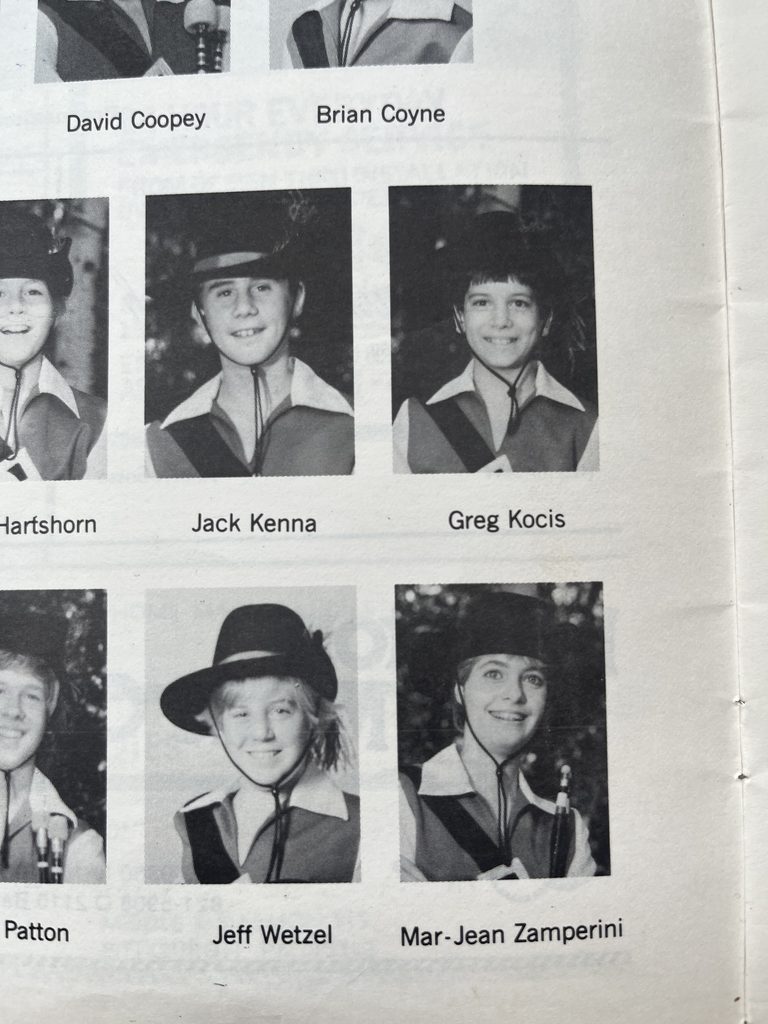
From 1984 through 1988, Kocis completed five full performance seasons with the North Hills Buccaneers Baton & Drum Corps.
The corps performed extensively during the spring, summer, and fall, with approximately 40 parades during the main performance season. Most performances took place throughout the Pittsburgh area, but the organization also traveled to other locations.
During his years with the Buccaneers, Kocis performed in places including:
- Hershey, Pennsylvania
- Philadelphia, Pennsylvania
- Montreal, Canada
- Ocean City, Maryland
Over five years, he progressed through several percussion instruments. His development included playing:
- Cymbals
- Bass drum
- Glockenspiel
- Triple toms
- Snare drum
His first year was spent playing cymbals. He moved to bass drum during his second year, followed by glockenspiel and triple toms before eventually becoming a snare drummer.
During his fifth and final year in 1988, Kocis was appointed drum captain by an instructor while playing snare drum.
The experience gave him extensive performance experience at a young age and established the discipline that would remain part of his approach to music.
North Hills Buccaneers Drum & Baton Cores Parade Schedules 1984 to 1988
Junior High School and Concert Band
While developing as a marching percussionist, Kocis also became involved in concert band.
He initially held the position of fourth-chair percussionist, but after approximately one year moved to first-chair percussionist.
He would continue playing at the first-chair level through both junior high and high school concert band.
During junior high school, Kocis also auditioned for the school’s jazz band.
The ensemble required only one drummer, and he was not selected. At the time, his musical interests and playing experience were much more heavily rooted in rock music.
The audition was nevertheless another step in his growing musical development.
Talent Shows and Early Small Ensembles
Kocis began performing outside traditional marching and concert-band settings while still in school.
In both junior high and high school talent shows, he performed a duet drum solo with another drummer.
Later, during high school, he performed with a small group consisting of a pianist, bass player, and Kocis on drums.
The group came together specifically for a talent-show performance and did not continue afterward.
Among the songs they performed was “Foreplay” by Boston. Kocis also remembers performing what may have been “Piano Man” by Billy Joel, although the exact song remains uncertain.
The performances gave him some of his earliest experiences playing popular music in a small ensemble outside the structure of school and marching organizations.
His First Drum Kit
After beginning his musical education through marching percussion, Kocis eventually wanted his own drum set.
Around the age of 12 or 13, his father purchased his first drum kit from Hollowood Music in McKees Rocks, Pennsylvania.
The kit was a used blue five-piece Slingerland drum set with Zildjian cymbals.
Kocis suggested an arrangement that would allow his father to purchase the entire kit while spreading the gift across multiple birthdays and Christmases.
Different parts of the drum set could be considered gifts over several years.
His father agreed.
The blue Slingerland gave Kocis the opportunity to move beyond marching percussion and explore the rock music that was becoming increasingly important to him.
Learning from Records
Kocis developed much of his drumming ability by playing along with records.
Rush became one of his most important early influences. He owned a drum-transcription book of Rush songs and spent weeks—and sometimes months—learning individual songs.
Among his favorites to learn and play were:
- “Subdivisions”
- “2112”
- “Limelight”
- “YYZ”
- “Tom Sawyer”
- “Red Barchetta”
Some of the songs were so technically demanding that he never completely figured them out.
That contrasted with albums such as John Cougar Mellencamp’s Scarecrow, which he could largely play by ear. Even then, he was aware of the more challenging parts played by drummer Kenny Aronoff.
Another album he enjoyed learning by ear was Metallica’s Master of Puppets.
For Kocis, playing along with records was not simply practice. It was one of his primary methods of learning how different drummers approached rhythm, dynamics, arrangement, and feel.
Expanding Musical Influences
While Rush and progressive rock remained important, Kocis’s musical interests continued to broaden during the late 1980s.
He listened to Pink Floyd, Yes, Iron Maiden, Van Halen, Led Zeppelin, Tom Petty, Paul Simon, Prince, John Mellencamp, and The Beatles, along with the heavy metal, hard rock, pop, and new-wave music surrounding him.
MTV was a constant source of new music when the channel was still heavily focused on music videos.
In Pittsburgh, album-oriented rock station WDVE provided another steady source of music.
His listening habits ranged from progressive rock and heavy metal to new wave and pop.
By the late 1980s, he was also becoming interested in bands such as Jane’s Addiction, the Red Hot Chili Peppers, and Metallica, artists who were not yet household names in the way they would later become.
The Red Hot Chili Peppers were particularly influential on his interest in funk-oriented rock drumming, while Chad Smith became an important influence.
He was also drawn to Stephen Perkins of Jane’s Addiction because of his distinctive, colorful, and aggressive approach to drumming.
Other drummers he studied and drew ideas from included Stuart Copeland, Dave Weckl, and Bill Bruford, along with other jazz-fusion-oriented players.
Kocis never became a jazz-fusion drummer, but he found himself borrowing ideas from musicians in the genre and incorporating aspects of their playing into his own approach.
He was interested in the ideas behind different styles rather than limiting himself to one particular type of drumming.
Expanding the Drum Kit
As his interest in rock drumming grew, Kocis expanded his original Slingerland setup.
Before having custom-made toms built to match the Slingerland drums, he experimented with Remo Roto Toms.
The Roto Toms appealed to him because they were practical as well as visually distinctive. A set provided several drums and a stand in one package, while being considerably easier to transport than a large collection of conventional toms.
Eventually, he had custom concert toms and regular toms made to match the original Slingerland style, including the finish and drum lugs.
He also added a second bass drum, creating a much larger drum setup.
By approximately 1988 or 1989, however, Kocis recognized a practical problem with having such a large kit.
Dragging an enormous drum kit to every gig was unnecessary and difficult to transport.
He therefore purchased a second five-piece black Yamaha drum kit.
The smaller Yamaha served two purposes: it was easier to transport to performances, while the larger Slingerland-based kit could remain set up for practice and other uses.
Eventually, before moving to New York City, Kocis sold the original Slingerland kit.
Early Bands and Playing with Friends
By 1989 and 1990, Kocis was beginning to play in various informal bands and projects with friends.
Some never progressed to performing publicly, but they gave him opportunities to play the music he was listening to.
He remembers playing songs such as Van Halen’s “Ain’t Talkin’ ‘Bout Love”, songs by Queensrÿche, punk material, and other hard-rock songs.
One project, called Rear View, performed cover songs in clubs around the Pittsburgh area. The group featured two female lead singers, with Kocis playing drums.
He also played an outdoor show in Enta, PA, with a band put together just for that show. He can’t recall the name of the band, but he remembers playing a cover of Jimi Hendrix’s ” Fire” but the way the Red Hot Chili Peppers played it.
At the same time, he was becoming increasingly interested in songwriting.
Rather than always being the drummer, he wanted to form a band in which he could play bass.
The motivation was simple: he wanted to be able to concentrate more on writing songs.
He worked with some guitarist friends and began writing several songs, but the project never developed into a full band and never performed publicly.
The desire to move from simply playing other people’s songs toward creating his own material was becoming increasingly apparent.of drumming.
Musical Influences
Kocis’s musical tastes developed across a wide range of styles.
Progressive rock became particularly important to him, especially artists such as:
He was also drawn to heavy metal, including Iron Maiden, as well as several of the pop-metal and glam-rock bands of the 1980s.
he also liked artist like Paul Simon, Prince, The Beatles
This broad range of influences would eventually become part of his approach to songwriting and music production.
Drumming Influences
Several drummers played an important role in Kocis’s development.
Among his major influences were:
- Neil Peart of Rush
- Phil Collins
- Bill Bruford
- John Bonham
- Kenny Aronoff
Neil Peart was particularly influential during Kocis’s early development as a drummer.
Bill Bruford’s work with Yes and King Crimson connected with Kocis’s interest in progressive rock, while John Bonham represented a powerful and influential approach to rock drumming.
Kenny Aronoff became another favorite, particularly for his work with John Mellencamp.
Kocis was drawn to the contrast between Aronoff’s direct, powerful style and the more technically elaborate approach of drummers such as Peart.
Expanding the Slingerland Kit
By approximately age 15 or 16, Kocis had begun expanding his original five-piece Slingerland drum kit.
He added custom-made concert toms and regular toms designed to match the original blue finish and drum lugs of the Slingerland set.
He also added a second bass drum.
The original used five-piece kit had gradually become a much larger drum setup.
Years later, before moving to New York City, Kocis sold the Slingerland kit. By then, he had purchased a Yamaha drum set.
He no longer owns any part of the original blue Slingerland kit.
Shaler Area High School: 1987–1990
Kocis attended Shaler Area High School, graduating with the Class of 1990.
Beginning in 1987, he performed with the Shaler Area High School marching band.
For two years, his involvement with Shaler overlapped with his final seasons in the North Hills Buccaneers.
The schedules generally did not conflict significantly because the Buccaneers performed primarily during the warmer months, while Shaler’s marching-band activities were centered around the school year, including football games and other school events.
Kocis also continued performing in concert band, holding the position of first-chair percussionist.
During his senior year in 1990, he was appointed drum captain by an instructor.
The appointment marked the second time he had been given a leadership role as drum captain, following his final year with the North Hills Buccaneers.
High School Musicals and Other Performances
In addition to marching and concert band, Kocis performed as a drum-set player in Shaler Area High School musical productions.
Although he no longer remembers the titles of the musicals, the experience exposed him to another type of musical performance.
Playing for theatrical productions required a different approach from marching percussion, concert band, or playing along with rock records at home.
Throughout junior high and high school, Kocis also participated in talent shows and other school performances, continuing to expand his experience as a live musician.
Mid-East Instrumental Music Conference
From 1987 through 1990, Kocis performed annually as a percussionist at the Duquesne University Mid-East Instrumental Music Conference, held at Pittsburgh’s William Penn Hotel.
The name “Mid-East” referred to the geographic region associated with the conference rather than Middle Eastern music as a genre.
The annual event added another significant performance experience to his musical education.
By the end of high school, Kocis had performed in drum corps, marching band, concert band, theatrical productions, talent shows, and instrumental music events.
Early Songwriting and the Four-Track Recorder
Around the age of 16, while still in high school, Kocis began experimenting with recording and writing his own songs.
He used a Tascam four-track cassette recorder, although he no longer remembers the exact model or where he purchased it.
His early recordings included combinations of:
- Drums
- Keyboards
- Vocals
- Possibly bass
He was already writing his own musical ideas, including melodies and lyrics.
Kocis now jokes that some of his earliest lyrics were not particularly good, but the experiments represented an important change in his musical direction.
At the same time, he was beginning to teach himself guitar.
His guitar skills had not yet caught up with the songs he wanted to create.
He remembers being unable to smoothly change between chords while playing. Instead of giving up on the idea, he used the four-track recorder to work around the problem.
He recorded one chord on one track and then recorded another chord separately on another track.
By layering the chords, he could create a chord progression that he was not yet capable of playing continuously.
It was a simple solution, but it revealed an instinct that would continue throughout his career: when he did not yet know how to accomplish something musically or technically, he experimented until he found another way to make the idea work.
The four-track recordings marked his earliest serious experiments with songwriting, arranging, and music production.Still, music was the dominant focus.
Working While Still in School
Beginning around the age of 16, Kocis also started working while attending high school.
His early employment included work in the food-service departments of a nursing home and later a hospital, where he worked as a dietary aide and cook.
The experience introduced him early to the challenge of balancing regular employment with his musical ambitions.
The California Trip
After graduating from Shaler Area High School in 1990, Kocis began considering what he wanted to do next.
Around November 1990, he traveled to California with several friends and stayed at a friend’s father’s apartment in Anaheim.
The group traveled into Los Angeles, and the trip exposed Kocis to a different musical environment.
At the time, he was interested in attending the Percussion Institute of Technology (PIT) in Los Angeles to pursue drumming.
For various reasons, however, the plan did not materialize.
Kocis returned to Pittsburgh and instead enrolled at the Art Institute of Pittsburgh, where he briefly studied music business.
The experience was short-lived, but it represented another step in his evolving relationship with music.
He was beginning to think not only about performing music but about the larger world surrounding the music business.
By 1990
By the time Kocis graduated from Shaler Area High School in 1990, music had already occupied much of his life for several years.
He had completed five full seasons with the North Hills Buccaneers, progressing through multiple percussion instruments and eventually becoming drum captain during his final year.
He had performed extensively throughout the Pittsburgh region and traveled to other parts of Pennsylvania, Maryland, and Canada.
He had advanced from fourth-chair to first-chair percussionist in concert band.
He performed in marching band, talent shows, high school musicals, and annual instrumental music conferences; played in local rock bands; and performed cover songs in Pittsburgh-area clubs.
He had developed a diverse collection of musical influences, from Rush and progressive rock to Metallica, the Red Hot Chili Peppers, Jane’s Addiction, classic rock, new wave, pop, and jazz-fusion drummers.
During his senior year, he was appointed drum captain of the Shaler Area High School percussion program.
At home, he had expanded a modest used Slingerland drum kit into a much larger setup and spent countless hours playing along with the records that influenced him.
And by his mid-teens, he had already begun experimenting with something that would eventually become just as important as drumming: writing and recording his own songs.
By 1990, Kocis was primarily a drummer.
But the songwriter and producer he would later become was already beginning to take shape.
Bands & Recording Studios
Bloodshoot
From 1991 to 1993, Kocis played drums in the Pittsburgh rock band Bloodshoot.
Bloodshoot’s sound blended 1970s classic rock with the harder modern rock emerging in the early 1990s. Kocis describes the group’s style as something like Pearl Jam meets Led Zeppelin.
The band recorded a four-song EP titled Emotional Laboratory at Audiomation Studio on Pittsburgh’s North Side. The sessions represented one of Kocis’s earliest experiences working in a professional recording studio.
By this point, he was also beginning to move beyond his role as a drummer. Kocis co-wrote one of the EP’s songs, “Rusty Nails,” giving him one of his earliest documented songwriting credits.
Around the same period, Kocis also recorded several songs at Automation Studio for a friend’s project called The Killing Minds. The project incorporated an electronic drum pad in the style of a Roland Octapad alongside acoustic drums, allowing him to combine electronic and traditional percussion.
The Killing Minds’ recordings moved in a different musical direction from Bloodshoot, blending hard rock and electronic music with elements of funk and rap.
These early studio experiences exposed Kocis to different approaches to recording and arranging music. While drums remained his strongest instrument, songwriting and shaping music in the studio became increasingly important parts of his identity as a musician.
- Audiomation Studio (closed)
Fun fact: The engineer for both Bloodshoot’s Emotional Laboratory sessions and Kocis’s recordings with The Killing Minds at Automation Studio was Joe West. West would later become a Grammy Award-winning producer, mixer, and hit songwriter, working with artists including Keith Urban, Toby Keith, Tim McGraw, and others. He also produced and mixed the 2017 Grammy Award-winning album Hymns That Are Important to Us by Joey + Rory.
The Earthworms
In 1993, Kocis became the drummer for The Earthworms, a Pittsburgh-area band whose music he remembers as earthy, folk-oriented, psychedelic, and decidedly unconventional.
The band’s songwriting was influenced by artists including The Sundays, 10,000 Maniacs, The Smiths, the Pixies, and R.E.M. Aside from R.E.M., Kocis was not particularly familiar with many of those artists at the time.
What drew him to the band was its combination of pop sensibility and more ambitious, complex arrangements. Some songs featured longer structures with multiple sections, an approach that reminded him of the progressive-rock arrangements of Yes.
The music could change dramatically from one section to another. A song might move from a funk-rock groove into a reggae-inspired section, creating arrangements that were constantly shifting and especially enjoyable for Kocis to play as a drummer.
The Earthworms’ lineup was also unusual for a band with such an eclectic sound. Both guitarists played acoustic guitar rather than electric guitar, while one also played mandolin on some songs. The group also included a bass player and a female lead vocalist, with a percussionist joining the band for some performances.
The Earthworms performed primarily original material, with approximately 95 percent of their repertoire consisting of original songs. They occasionally performed covers, including “Cactus” by the Pixies and “Winter Long” by Neil Young.
“Cactus” would start as a relatively faithful performance of the song before developing into an extended, all-out jam session.
The band became part of the region’s active independent music scene and performed at notable Pittsburgh venues, including Nick’s Fat City and The Artie, as well as at regional music festivals.
The Earthworms also performed at the Great Blue Heron Music Festival and opened for the Pittsburgh band Rusted Root on multiple occasions.
The band’s work was documented on the 1993 Blue Duck Records compilation Duck Tracks, which featured a collection of Pittsburgh-area bands. The Earthworms contributed the song “Weasel.”
Footage of the Earthworms performing in 1993, along with recordings from some of the music festivals where the band appeared, has also survived on YouTube.
For Kocis, the Earthworms period was significant because it exposed him to a different kind of songwriting and arrangement than the more straightforward hard-rock music he had played previously. Although he did not contribute to the band’s songwriting, performing the material expanded his musical vocabulary and reinforced his growing interest in complex song structures, changing grooves, and the possibilities of song arrangement.
At the same time, Kocis was becoming increasingly interested in writing songs himself. As a capable drummer, however, he often found that other musicians primarily wanted him behind the drum kit—a tension that would eventually encourage him to pursue songwriting and recording more independently.
Fun Fact
Fun Fact: In 1993, at just 19 years old, The Earthworms’ lead vocalist Nikki Ferraro auditioned for 10,000 Maniacs after Natalie Merchant left the band. At the same time, The Earthworms were themselves drawing inspiration from 10,000 Maniacs—making the connection an especially interesting twist in the band’s story.
Learning to Write Songs
Kocis began experimenting independently with songwriting and recording using a Tascam four-track recorder.
Because he wanted greater independence as a songwriter, he began teaching himself additional instruments. He played some keyboards and bass and started learning guitar specifically so that he could write songs without having to depend entirely on other musicians.
The transition was gradual. He did not suddenly stop being a drummer and decide to become a producer. Instead, songwriting, playing, and production began merging together.
For Kocis, producing a song became part of writing it. If he had an idea, he wanted to hear what it could become. Recording was the way to turn a collection of riffs, melodies, lyrics, and rhythms into something resembling a finished piece of music.
That instinct would eventually lead him away from relying primarily on bands and toward an increasingly independent creative process.
The First Macintosh and Electronic Experimentation
In 1994, Kocis purchased his first Macintosh computer and began experimenting with computer-based sequencing.
Using external MIDI instruments, including the Roland JV-1080 and Korg Wavestation, he explored the possibilities of creating music with computers and synthesizers. He also used MOTU Studio Vision.
Much of this early work was instrumental and experimental. He was not necessarily trying to create commercially viable songs. Instead, he was exploring sounds, sequencing, arrangements, and the emerging possibilities of computer-based music production.
At the time, the technology itself was still an important part of the creative process. Learning how to connect MIDI equipment, sequence instruments, and make a computer communicate with external hardware required experimentation and patience.
Those early sessions represented an important step toward the production-centered approach that would later define much of his musical work.
Looking Beyond Pittsburgh
By the late 1990s, Kocis was looking for a major change.
He and some friends had originally discussed moving to California, but those plans never materialized. Rather than remain in Pittsburgh, Kocis made the decision to move to New York City alone.
In 1998, at approximately 27 or 28 years old, he left Pittsburgh and headed to New York.
He arrived with approximately $500 and no permanent place to live.
It was the beginning of one of the most chaotic periods of his life.
New York City
Arriving With $500
When Kocis first arrived in New York City, he had little money and nowhere permanent to stay.
He found an all-male hotel near Madison Square Garden through an advertisement in the Village Voice. The newspaper would prove unexpectedly important during his early years in New York, helping him find not only temporary housing but eventually a more permanent place to live.
Kocis already had experience working for T.G.I. Friday’s in Pittsburgh and transferred to a New York City location.
The transfer provided a way to earn money, but it did not immediately solve the problem of housing.
He eventually stayed with a female coworker and her roommate, sleeping in their living room. Later, he attempted to rent an apartment with another coworker.
The arrangement appeared promising until the realtor took their security deposit and failed to provide the apartment. Although they eventually recovered the money, Kocis once again found himself without a place to live.
He later found a shared apartment in Astoria, Queens, where he lived for approximately six months.
Then the apartment flooded.
Forced to leave, Kocis spent a night in a cheap Manhattan hotel before taking his belongings back to Pittsburgh.
But the story did not end there.
He returned to New York City.
Back to New York
During one of his returns to New York, Kocis even slept in his car on the Upper West Side.
He eventually returned to the all-male hotel near Madison Square Garden. The hotel itself was only a temporary solution. Residents had to move out approximately every three weeks, forcing Kocis to periodically find other places to stay.
At different times, he stayed with friends and coworkers.
One of the people he remembers from that period was Kate, a woman from England who lived near the hotel and allowed him to stay with her for several nights. At other times, he stayed with coworkers from T.G.I. Friday’s.
Eventually, after another search through the Village Voice, Kocis found an advertisement for income-restricted housing on 28th Street in Manhattan.
He applied.
And eventually, he got in.
After years of moving between Pittsburgh and New York, temporary hotels, couches, shared apartments, and unstable arrangements, he finally had a more permanent place to live.
Kocis would remain in the 28th Street apartment for approximately 14 years.
Trying Other Paths
During his early years in New York, Kocis did not immediately become part of another band.
He auditioned for some groups but worked primarily on his own music. Transporting drums around New York without a car was another obstacle, although he later realized that many New York clubs already had drum kits available for performers.
At the time, however, he increasingly worked alone.
He continued writing songs and learning how to produce his own music.
He also decided to experiment with another part of New York’s entertainment world: film and television.
Kocis worked as an extra on several productions. One involved actress Sandra Bullock, although he later watched the completed film and discovered that he had not made the final cut.
He also remembers appearing in a separate Claritin commercial, although the exact details of the production still need to be identified.
These experiences did not become a full-time acting career, but they were part of a period when Kocis was exploring possibilities while trying to establish himself in New York.
Finding His Way Into Production
Around 2001, Kocis began recording his own music using Logic.
Before choosing his recording software, he visited music stores in New York’s Music Row area, including Manny’s Music and Sam Ash, asking for advice about the best software available for recording at the time.
Logic, then owned by Emagic, became his primary platform.
He also experimented with Reason 1.0 and Ableton Live. At the time, Reason did not yet offer audio recording capabilities. Kocis enjoyed Ableton Live but ultimately continued working primarily in Logic.
His production setup was far from a conventional studio.
He lived in a studio apartment and built a small place to produce music inside the space where he lived.
Learning music production in the early 2000s required a different kind of persistence than it would years later. There were no endless YouTube tutorials available for every problem. There were no massive libraries of online courses covering every aspect of recording and mixing.
Kocis learned through experimentation, trial and error, and music-production magazines.
It would take years before he felt truly comfortable with the technical side of producing music.
A Job Near the World Trade Center
By 2001, Kocis was still supporting himself through restaurant work.
After working at T.G.I. Friday’s in New York, including time as a bartender, he eventually began working at Chevys Fresh Mex near the World Trade Center.
He started the job in March 2001.
Only a few months later, everything changed.
September 11
On September 11, 2001, the attacks on the World Trade Center transformed lower Manhattan and the lives of countless people who lived and worked nearby.
Kocis’s workplace was affected by the aftermath. The building where he worked was closed, leaving the employees without work.
He had only been at the job for a few months.
The closure lasted for approximately a year, and Kocis was out of work during that period before eventually returning.
The sudden loss of employment created another uncertain period in his life.
But it also created time.
The Drum Loops
While out of work, Kocis spent much of his time in his apartment working on music.
Drawing on his years of experience as a drummer, he began creating drum loops.
At some point, he noticed that other musicians and producers were selling drum loops online through eBay.
He thought he could do the same.
So he began making and selling his own loops.
At first, it was simply an experiment.
But the idea would eventually lead toward something much larger: the creation of digital music products, sample libraries, and an online business built around music production.
A difficult year had unexpectedly opened a new door.
The Long Road of Independent Songwriting
Writing Without a Singer
While Kocis continued developing as a producer and songwriter, one recurring challenge remained: he was not primarily a vocalist.
He could write songs, play instruments, create arrangements, and build productions, but finding the right voice for a song was often difficult.
Beginning around 2009, he began hiring vocalists online through services such as StudioPros to sing professional demos of his songs.
Songs from this period included:
- “Don’t Worry About It”
- “I Hope You Find What You’re Looking For Next Time”
- “In Memory of Melody”
The process was not always simple.
A vocalist might interpret a melody differently than Kocis imagined. Sometimes the wrong words were sung. Sometimes revisions were needed. In other cases, the performance simply did not fit the song.
The process could become expensive.
For at least one song, Kocis hired five different vocalists before finding a performance that worked.
These frustrations were not simply technical problems. They reflected the challenge of being an independent songwriter without a permanent singer or band.
Over time, the search for ways to bring his songs to life would lead him toward new technologies.
Working Nights
During the late 2000s and 2010s, Kocis continued balancing his creative ambitions with restaurant work.
In 2009, he worked as a bartender in Union Square. During this period and in the years that followed, he continued working late nights while writing and producing music independently.
The lifestyle could be punishing.
Years of working nights often meant going to bed at five or six in the morning while continuing to spend time pursuing music and creative projects.
All the while, Kocis continued writing songs.
A Return to Live Music
Around 2015, Kocis returned to live performance in a different way.
He began playing acoustic guitar and performing cover songs in Central Park with friends he worked with. They were not a formal band and were not doing it for money. It was simply something they enjoyed doing.
The experience eventually led to another opportunity.
Kocis began playing bass in a band formed with coworkers. The group primarily performed cover songs, but he also brought some of his own songwriting into the project.
He performed his original song “Could Have Been So Easy” live at Arlene’s Grocery in New York City.
He also received a songwriting credit on the band’s EP, which was recorded after he had left the group. By that point, the band had changed its name to Lady Strange.
The details surrounding the band, the EP, and his specific songwriting credit remain to be fully documented.
Burnout
By the late 2010s, the accumulated pressure of years of night work, independent music production, songwriting, and attempts to build an online career had begun to take a toll.
Kocis had spent years trying to build something creatively while maintaining jobs that paid the bills.
In 2019, he experienced a period of burnout and career instability after losing a restaurant job following a guest complaint.
The experience became part of a larger personal turning point.
YouTube and Affiliate Marketing
An Accidental Beginning
In 2012, Kocis started the GregKocis YouTube channel.
At first, the channel did not have the clear identity it would later develop.
He posted a variety of content and was not specifically trying to create a channel devoted to music production, plugins, or audio technology.
Over time, however, the channel began generating income.
Kocis also began earning some money through affiliate marketing.
The growth was gradual and largely organic.
As his experience with music production deepened, the channel increasingly became connected to the tools he was using and the techniques he was learning.
Learning the Business of Online Work
In 2017, Kocis joined Wealthy Affiliate, an online affiliate-marketing training community that he continues to use.
The experience helped him learn more about building websites, creating online content, and using affiliate relationships as part of an independent online business.
By 2019, he had started a more dedicated affiliate-marketing channel.
The connection between music and online work was becoming increasingly important.
The same musician who had once experimented with selling drum loops on eBay was now using YouTube, websites, and affiliate marketing to build new sources of income.
Insomnia and an Unexpected Test
In May and June 2019, during a period of unemployment and uncertainty, Kocis experienced severe insomnia.
For days at a time, he struggled to sleep. When he did sleep, it could sometimes be only for a few minutes. Other times, he would lie down for hours without falling asleep.
The experience was deeply frustrating and depressing.
At the same time, he needed to find work.
Kocis began training for restaurant jobs while severely sleep-deprived. He remembers going into training after days without sleep and somehow managing to function.
One job lasted only a couple of days. Another lasted approximately a month.
Eventually, he began working at the Hard Rock Cafe.
He remembers taking his final test for the position without having slept the night before.
Kocis had experienced a much shorter episode of insomnia years earlier following a concussion, around 2004, but the 2019 experience was far more prolonged and disruptive.
Eventually, he was able to return to a more normal sleep schedule.
The period represented another difficult chapter in a life that had repeatedly required adaptation.
Hard Rock and the Pandemic
Kocis began working at the Hard Rock Cafe in 2019 and had been there for approximately seven months before the effects of the COVID-19 pandemic resulted in an extended closure.
The following period would once again give him an unexpected amount of time away from regular work.
For approximately 14 months during 2020 and 2021, Kocis spent much of his time at home.
Once again, he turned heavily toward music.
A New Period of Musical Education
Online Courses and Collaboration
During the COVID period, Kocis began an intensive period of online musical education.
He participated in songwriting courses and collaborated with other writers online.
He also began taking courses through Monthly.com, later known as Studio.com.
The platform offered courses taught by prominent musicians, producers, and songwriters.
Through a referral program, Kocis promoted courses using his YouTube channel. The program provided course credits rather than direct cash payments, allowing him to take additional classes.
Over time, he accumulated approximately 100 courses in music production and songwriting.
The instructors and programs he studied included courses associated with artists and producers such as:
- Ryan Tedder
- Kygo
- Charlie Puth
- Luis Bell
and many others.
For someone who had largely taught himself production through experimentation and magazines decades earlier, the availability of structured online education represented a dramatic change.
Kocis also continued studying mixing, production, mastering, and songwriting through other educational programs.
SongChasers and Nashville
Around 2021 and 2022, Kocis joined SongChasers, an online songwriting community and educational program associated with Full Circle Music in Nashville.
The program introduced him to a more collaborative approach to songwriting.
Through Zoom sessions and online workshops, he participated in co-writing with other songwriters.
He also traveled to Nashville for SongChasers-related events and co-writing opportunities.
The experience exposed him to new writers and new approaches to songwriting.
Not all of the collaborations resulted in completed or released songs.
Kocis eventually became frustrated with the difficulty of finishing some songs that had been started collaboratively. He returned increasingly to the independent songwriting process that had defined much of his earlier work.
He also joined the Reverse Engineer program, gaining lifetime access to additional training in audio production, mixing, and mastering.
Searching for the Right Voice
Professional Vocalists
Kocis continued searching for ways to bring his songs to life through other singers.
Around 2021 and 2022, he hired vocalists through online freelance platforms.
Among the singers he worked with was Liel Bar-Z, who performed vocals on songs including:
- “Beautiful Day, Beautiful Life”
- “No More”
- “Could’ve Been So Easy”
The collaboration sometimes required Kocis to rethink the productions themselves.
In two cases, he substantially reproduced the entire backing track because the original production did not fit the way the vocalist naturally performed the song.
The experience reinforced a lesson Kocis had been learning for years: a song could change dramatically depending on who performed it.
Synthesizer V
Kocis eventually began experimenting with Synthesizer V Studio, a vocal-synthesis program.
The software provided another way to work with vocal melodies and lyrics.
He could program melodies using MIDI and a piano-roll interface, enter lyrics, and create vocal performances through a virtual singer.
The technology became useful not only for creating demos but also for songwriting itself.
It gave Kocis another way to experiment with:
- melodies
- vocal phrasing
- lyrics
- harmonies
- arrangements
without immediately needing to hire a human vocalist.
He wrote many songs using this process.
In retrospect, the technology represented another important transition.
Kocis had moved from:
playing drums in a band
to
teaching himself guitar so he could write songs
to
recording those songs himself
to
hiring singers
to
programming vocal performances.
The next step would take that process somewhere he could not have imagined when he bought his first four-track recorder.
AI-Performed Music
By 2026, Kocis had begun exploring AI-assisted music creation as a new way of revisiting songs he had written throughout his life.
For him, AI-generated performances represented a continuation of a much longer search for ways to hear his songs performed.
Rather than beginning with AI, he arrived at it after decades of experimenting with bands, home recording, professional vocalists, vocal-synthesis software, sequencing, and music production.
His current work explores the idea of human-written songs performed or reinterpreted with the assistance of AI.
Many of the songs he revisits have their origins years earlier.
Some began as acoustic ideas. Others were developed into production demos. Some were recorded with hired vocalists. Others were created using virtual singers.
AI now provides another way to explore how the same underlying song might sound in different genres, arrangements, and performances.
Kocis has emphasized the distinction between the songwriting and the performance process, describing his work as songs written by a human and performed or reinterpreted using AI technology.
An Ongoing Story
Greg Kocis’s story is not a simple story of immediate success.
It is a story of adaptation.
He began as a young drummer performing parades in and around Pittsburgh.
He played in local rock and psychedelic bands and recorded his first EPs.
He taught himself guitar because he wanted to write songs.
He bought a four-track recorder because he wanted to hear those songs.
He bought a Macintosh computer and began sequencing because he wanted to explore new sounds.
He moved to New York City alone with approximately $500 and nowhere permanent to live.
He worked restaurant jobs while trying to find his place in the city.
He experienced homelessness and unstable housing before eventually finding a permanent apartment.
He tried acting as an extra.
He learned Logic.
After losing work following September 11, he began making drum loops and selling them online.
He spent years working nights while continuing to write and produce songs.
He hired singers when he could not find the right voice.
He built a YouTube channel without initially knowing exactly what it would become.
He studied songwriting and production through hundreds of hours of courses and collaboration.
He traveled to Nashville to write with other musicians.
And after decades of trying to find new ways to bring songs from his imagination into the real world, he began exploring a new generation of musical technology.
The story is still being written.
And there are still many missing chapters.
There is more to learn about the Pittsburgh years.
There is a larger story behind the early New York years.
There is an entire chapter still to be written about the drum-loop business and the digital music products that followed.
There is more to document about his YouTube career and the development of his work as an online music educator and affiliate marketer.
There are songs, recordings, collaborations, jobs, setbacks, performances, and experiences still waiting to be placed on the timeline.
For now, this is not the final biography.
It is the beginning of a record.
And like the music itself, the story continues to evolve.